
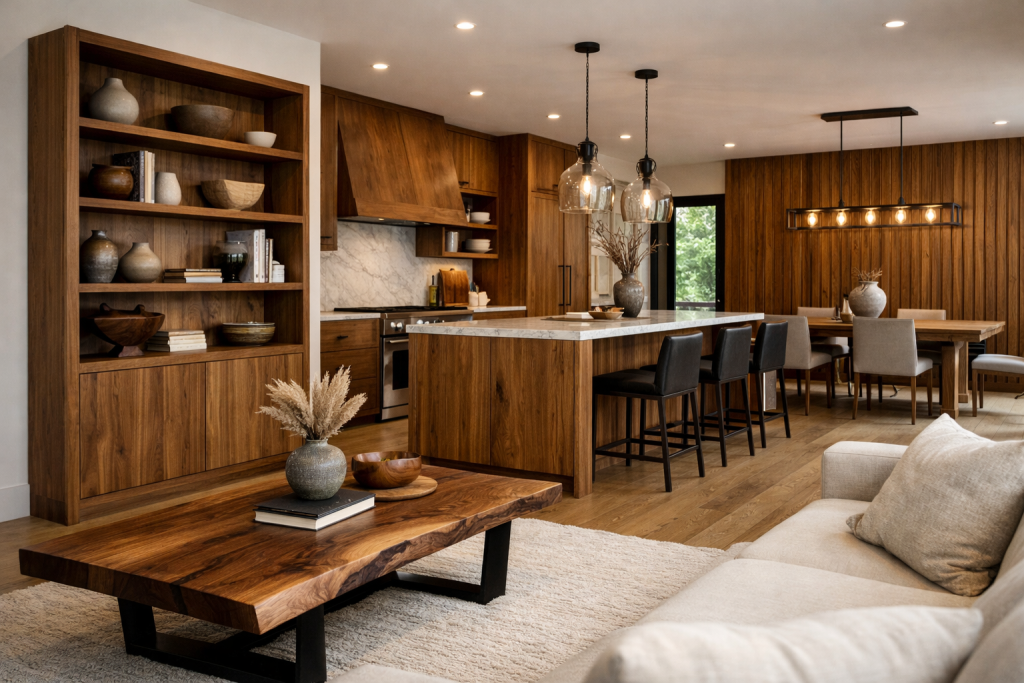
I’ll be honest – I didn’t think much about wood furniture until a shelf I bought online collapsed under the weight of about twelve books and a small plant. Not a dramatic collapse. Just a slow, sad lean to one side over the course of a week until it gave up entirely. It was made of something the listing called “engineered wood,” which I now understand means compressed sawdust held together by optimism.
That was the moment I started paying attention to what things are actually made of.
And apparently I’m not alone. There’s been a quiet but pretty noticeable shift happening in how people think about the stuff they put in their homes. Custom wood products – real ones, made by people who actually know what they’re doing – are having a moment. Not in a trendy way. More like a “we forgot this existed and now we remember” kind of way.
Why Flat-Pack Lost the Plot
Flat-pack furniture made sense for a while. It was cheap, it was available, and it got the job done. Nobody’s arguing with that. But there’s a ceiling to how many times you can reassemble a wobbly bookshelf before you start wondering if there’s a better way to live.
The real issue isn’t the price. It’s that most mass-produced furniture isn’t designed to last. It’s designed to be affordable and look okay in a photo. Once it’s in your home and you’re actually using it daily, the cracks start showing – sometimes literally. The veneer peels. The drawer stops closing properly. You move apartments and something that survived the journey technically, but is now held together by one remaining dowel and a prayer.
Custom wood doesn’t do that. A well-made wooden piece – whether it’s a bed frame, a door, a tabletop, a set of steps – is built to be used for years.
The Pandemic Changed How People See Their Homes
This sounds like a cliche at this point, but it’s true. A lot of people spent an uncomfortable amount of time staring at their living spaces during lockdown and realised they didn’t actually like them very much. The ultra-minimal, cold, Instagram-ready aesthetic started feeling a bit hollow when you were stuck inside it for months.
Wood is warm. Genuinely warm – not in a marketing copy kind of way but in a tactile, physical sense. It changes slightly with the seasons. It picks up small marks over time that somehow make it look better rather than worse. There’s a reason people describe wooden spaces as feeling “lived in” like it’s a compliment, because it is.
The other thing wood does that synthetic materials can’t pull off is age gracefully. A hardwood floor that’s been walked on for ten years looks richer than it did the day it was installed. Try saying that about laminate.
Custom Means It Actually Fits
Here’s a practical thing nobody talks about enough. Standard furniture sizes don’t match real rooms. They match showrooms, which are designed to make standard sizes look like they fit perfectly. Your actual home has an awkward alcove, a ceiling that drops on one side, a wall that isn’t quite straight, and a doorframe that’s slightly off because the building is old.
Custom production solves all of that in one go. You describe what you need, the dimensions get made to match, and the result is something that looks like it was always supposed to be there. Not something you worked around.
Where the Craft Actually Comes From
There’s been growing interest in where things are made and by whom. That’s partly a sustainability conversation and partly just people wanting to feel like their money went somewhere real.
Custom wood manufacturers across Asia have quietly been some of the best in the world at this for a long time. Woodworking in many parts of the region isn’t a recent industry – it goes back generations, supported by access to genuinely exceptional hardwood species. Countries known for quality wood products, especially in the Philippines and across Southeast Asia, have the kind of accumulated craft knowledge that you can’t manufacture quickly. It takes decades. The global market is only now starting to catch up to what was already there.
It Doesn’t Have to Be an All-or-Nothing Decision
Custom wood used to feel like something you committed to fully or not at all. Either you’re doing a complete bespoke renovation, or you’re back at the flat-pack store. That’s not really true anymore.
A lot of people are making selective upgrades – one solid wooden door instead of the hollow standard one, a handmade tabletop on an otherwise simple base, wooden wall cladding in a single room. Small decisions that make a real difference to how a space feels without requiring a complete overhaul of your budget or your home.
It’s a more honest way to approach it, honestly. Pick the things that matter most to you and do those properly.
The Short Version
Custom wood is back because people got tired of replacing things. Tired of furniture that looks fine and feels cheap. Tired of spaces that don’t quite fit. There’s nothing complicated about it. When something is made well from a material that lasts, it turns out people want that. They always did. It just took a few years of living with the alternative to remember it.